November 22, 2023, will mark the sixtieth anniversary of the assassination of President John F. Kennedy, who served 1,000 days in office before being struck down by an assassin's bullet, to the dismay of the country.
Kennedy flew to Texas on November 21, 1963, to smooth over differences between the liberal and Conservative wings of the Democratic Party and drum up support for his policies. He was set to run for reelection the following year and needed the Lone Star State to win. (1) Air Force One, the president's plane, landed near Fort Worth at approximately 11:07 p.m. After greeting well-wishers, the president and first lady retired to their room at the Hotel Texan.
The following morning, Air Force One departed for Love Field in Dallas. Kennedy and his wife enjoyed breakfast with Texas dignitaries before engaging in other official business. Later that day, as the presidential motorcade made its way through downtown Dallas, with Mrs. Kennedy and Governor Connally of Texas, seated with the president in a car with a roof open, he, the president, was shot twice, once in the neck and once in the back of the head, with the latter striking the fatal blow. The governor received a gunshot wound to the arm, with the first lady unharmed but badly shaken. The route was lined with cheering fans, shocked at what had happened.
Lee Harvey Oswald, an employee in the Texas School Book Depository, where the shots were fired, was apprehended by the FBI approximately two hours later while trying to sneak into a movie theater. (2) Later that evening, he was charged with the murder of Dallas policeman J.D. Tippit, whom he came into contact with while on the run. (3) The following day, Oswald was booked for the killing of the president when the ownership of a Mannlicher-Carcano rifle perched on a stack of books on the library's sixth floor was traced back to him. Oswald proclaimed his innocence and insisted he was being used as a pawn and that the actual killer was still out there. He was shot and killed the next day on live television by business owner Jack Ruby, increasing speculation of a conspiracy to kill the president.
Kennedy's death shocked every American, regardless of race or party affiliation. Upon taking office, he pledged to put a man on the moon, fight for human rights at home and abroad, and end the nuclear arms race between the Soviet Union and the United States. The Kennedy presidency also ushered in a New Frontier of ideas that inspired young people to be of service to mankind and challenged all Americans to shoot for the stars during turbulent times. The late president lives on in the memory of those who knew and loved him and will never be forgotten.
Source:
Wednesday, June 28, 2023
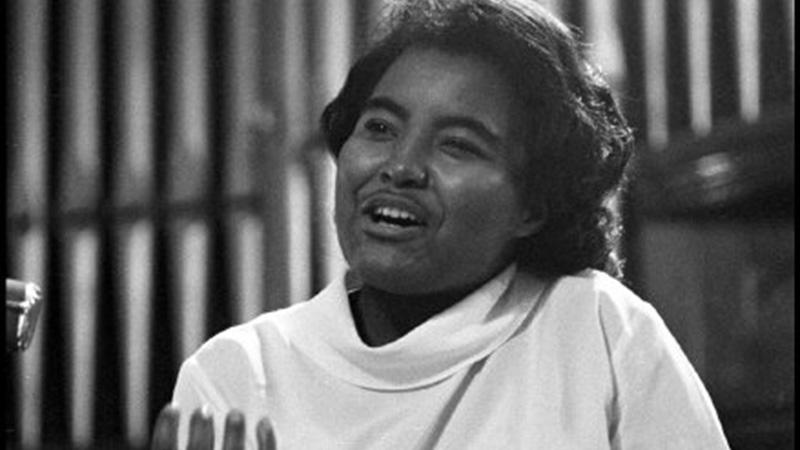
PRATHIA HALL
Posted on
“As God’s child … I am everything that I’m supposed to be. It may cost my job, it may cost my life, but I want to be free, and I want my children to be free. So I’m going down to the courthouse, and I’m going to sign my name. And I’m going to trust God to take me there, and I’m going to trust God to bring me back.”
Prathia Hall
Martin Luther King Jr. once said, “Prathia Hall is the one platform speaker I would prefer not to follow.” Prathia Hall was the daughter of a Philadelphia minister who passionately worked for racial justice, and she followed in his steps. Hall left college one credit away from graduation to join the Student Nonviolent Coordinating Committee (SNCC) in Georgia where she did voter registration and education work in “Terrible” Terrell County.
In the two years after Hall’s arrival, white terrorists bombed or burned 41 black churches. Hall, who had a reputation as a powerful and moving orator, spoke at a meeting following one of these devastating burnings. In one prayer she repeatedly said, “I have a dream,” – words said to have inspired Martin Luther King’s famous speech.
In Hall’s “deep passion for justice,” she grappled with the intense fear and anger that accompanied her work. “How much of this can human beings take? Even though I fiercely wanted to be a responsible, non-violent participant in this struggle that was no easy feat.”
Looking back on the movement, Hall saw there needed to be space “for the expression of authentic anger, even rage … we might have had even greater power if we had somehow found a way to allow space for the expression of righteous anger.” This was not the case, and in 1966, when SNCC began to move away from its principles of nonviolence, Hall resigned to take up the role of minister at her father’s old church. She pastored there for nearly 25 years and never stopped preaching for justice.
What does Juneteeth mean to me? Texas finally got the word slavery had ended, and we got the freedom that should have never been denied, and there is a new day for us to realize our goals.
"Truth may be crucified and justice buried, but one day they will rise again. We must live and face death if necessary with that hope."...Dr. Martin Luther King, Jr.
undisguised terror,” as described by Ukrainian President Volodymyr Zelensky. In a matter of days, hundreds of people have been killed, thousands are displaced, and hundreds of thousands are aiming to flee to border countries that accept refugees. Newborn babies are being placed in underground bunkers and men over the age of 18 are barred from leaving and asked instead to pick up arms and fight. There are images of courageous women staying in Ukraine to do the same.
The United States and many other countries have instituted severe economic sanctions to try to deter Russia’s offensive military tactics. And yet, Vladimir Putin seems set on trying to reclaim Ukrainian land through strong military force. At his first State of the Union address, President Biden enhanced sanctions by “closing off American airspace to all Russian flights.” The economic impacts on the Russian economy will be far-reaching and the human impacts will be generational.
So far, Russia does not seem deterred by the sanctions. Videos of the brutality are painful to watch. And the images of people trying to flee battle-stricken areas and cross the Ukrainian border into other countries further highlight the stain and peril of human survival. This journey has proved to be particularly challenging for Black people who, even during a life-and-death situation, have found themselves running into racist barriers to their safety and freedom.
There are many reports of Black people being refused at border crossings in favor of white Ukrainians, leaving them stuck at borders for days in brutal conditions. Ukraine stated they would first allow women and children on trains and transport out of the country to flee the Russian invasion. However, it seems they meant Ukrainian and European women and children. Videos show Black people being pushed off trains and Black drivers being reprimanded and stalled by Ukrainians as they try to flee. There are even reports of animals being allowed on trains before Africans.
Black students and athletes are not exempt from these racial barriers. Professional Ukrainian basketball player, Maurice Creek, who is originally from Maryland and played college basketball for Indiana University and George Washington University, was stuck in a bomb shelter in Mykolaiv, Ukraine. He is headed for Romania to try and get a flight to the United States. Ukrainian medical student, Korrine Sky, who is from Zimbabwe and lives in Great Britain, stated that trying to leave Ukraine is like “Squid Games” with Ukrainians and Europeans at the top of the hierarchy, people from India and the Middle East in the middle, and Africans at the bottom. Though Sky’s perspective is disturbing, there is relevant history that people may not know.
Africans attending schools in what is now Ukraine date back to the 1920s, and the Soviet Union (now Russia) started formally recruiting Africans to attend college and professional schools in 1957. Not a coincidence, 1957 was the year that Ghana gained its independence from Great Britain. The Soviet Union wanted to try and build more positive relations with African countries and showcase to the world their growing diplomacy. When Ukraine gained its independence from the Soviet Union in 1991, scholarships to African students substantially decreased. However, African students still found schools in the area appealing. Today, over 16,000 African people are studying in Ukraine, accounting for more than 20% of Ukraine’s international students.
Though the pathway to a visa in Ukraine and less expensive education costs are appealing to African students, economic depressions in southeastern Europe resulted in the rise of anti-immigrant prejudices and racial discrimination against Africans. Following a series of race-related murders of Africans in 2007, Ukraine passed anti-racism legislation. Hate crimes decreased to a certain extent. Still, Africans report regular occurrences of racial prejudice and name-calling (like “monkey”).
Comments made by Ukrainian officials and journalists covering the conflict reveal this deep-seated racial bias. In describing the traumatic impact of the Russian invasion to the BBC, Ukraine’s former deputy general prosecutor David Sakvarelidze stated: “It is really emotional for me because I see European people with blue eyes and blond hair being killed, children being killed every day with Putin’s missiles.” Al Jazeera English news anchor, Peter Dobbie, described people in Ukraine who were fleeing to Poland, Hungary, Romania, and Moldova: “We are playing some of the latest pictures of refugees on trains trying to get on trains or get out of Ukraine. And what’s compelling is just looking at them the way they are dressed. These are prosperous, middle-class people. These are obviously not refugees trying to get away from areas in the Middle East that are still in a big state of war. These are not people trying to get away from areas in North Africa. They look like any European family that you would live next door to.” On CBS News, senior correspondent Charlie D’Agata reporting from Kyiv stated: “With all due respect, this not a place like Iraq or Afghanistan that has seen conflict raging for decades. This is a relatively civilized, relatively European, I have to choose those words carefully too, city where you wouldn’t expect that or hope that it’s not going to happen. So it’s partly human nature…”
“European” has become a code word for white and a justification of the primary reason that people should care about the conflict, displacement, and killing. Bloody conflicts in Syria, Somalia, and other places have not received the wide-reaching international media coverage—or urgent international government action—that the invasion of Ukraine has inspired. This is not surprising. We simply have to look to the ongoing COVID-19 pandemic and which groups of people, communities, and countries have had equitable access to testing, treatment, and vaccination. Much like how the history of African enslavement in the United States still haunts our country in many ways, the legacy of African colonization in Europe is still surfacing, even amid a war that threatens the very existence of an entire country.
As the United States and the world offer their support to Ukraine in their fight for freedom, we cannot abandon the equitable deployment of civil and human rights. All people, regardless of race or nationality, must be equally allowed access to cross borders to safety. As we pray and hope for an end to the Russian invasion, I hope we realize there is much work to do during peacetime to ensure that everyone has equitable access to the same civil rights and dignity during conflict. We should care about the humanity and lives of people regardless of their race, ethnic origin, nationality, education, or social class background.